Selecting the Gold Standard: A Guide to Raw Material Procurement in the Fish Processing Industry
By. Nugroho Luhur - 14 Mar 2026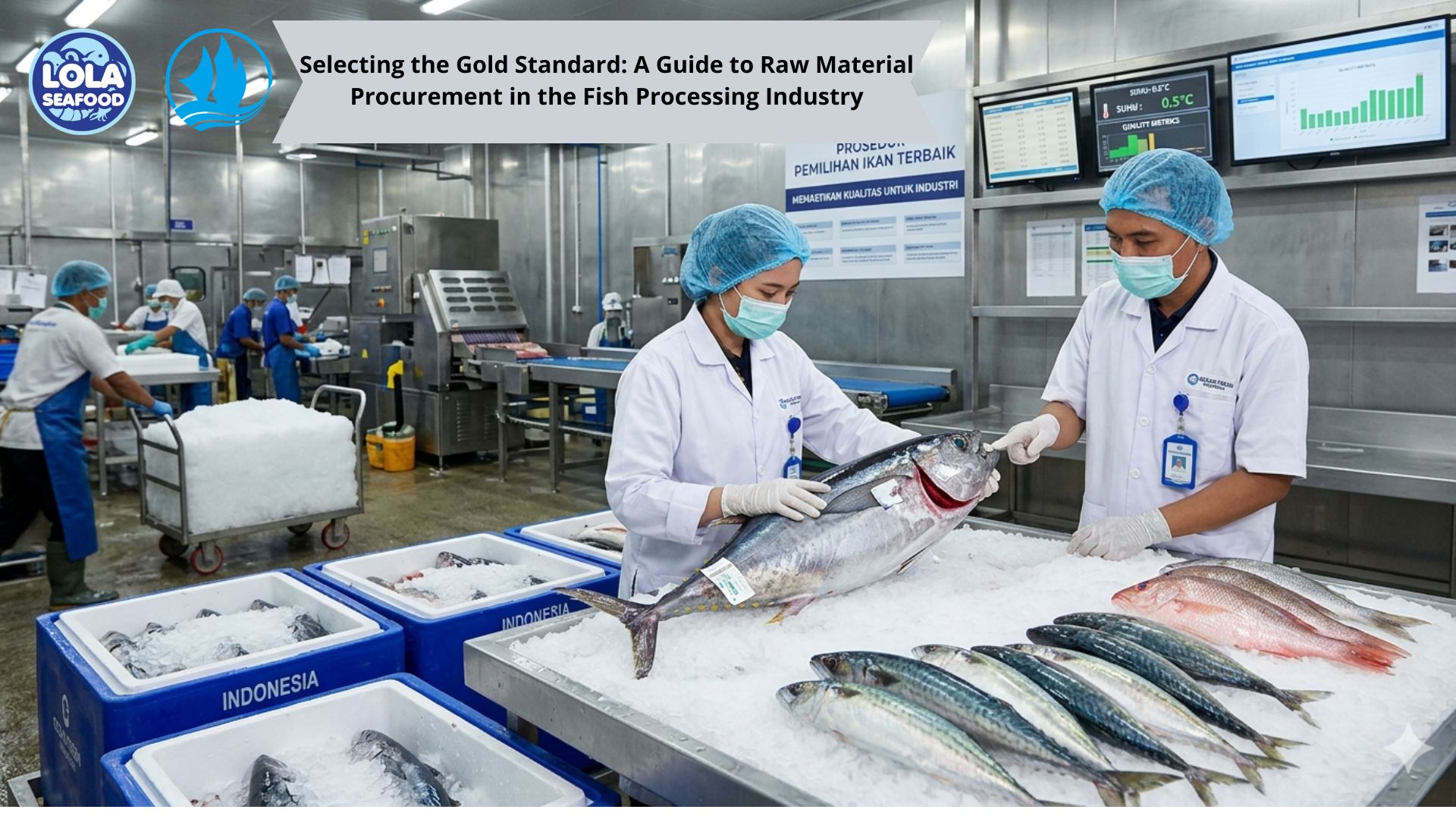
kelolalaut.com In the high-stakes world of the fish processing industry, the quality of the final product—be it canned tuna, frozen fillets, or premium surimi—is determined long before the first machine is turned on. It is an industry governed by the uncompromising rule: "Quality in, quality out." Unlike livestock, fish are highly perishable biological entities that begin to degrade the moment they leave the water.
Therefore, establishing a rigorous, science-based selection procedure for raw fish is not just a matter of culinary excellence; it is a critical pillar of food safety, economic efficiency, and brand reputation.
1. The Critical Window: Timing and Temperature
The most formidable enemy in fish processing is autolysis (self-digestion by enzymes) and microbial proliferation. The selection process must prioritize fish that have been handled with an unbroken cold chain.
- The Golden Rule: Fresh fish should ideally be kept at temperatures approaching $0°C$ (32°F).
- Sensory Evaluation: Upon arrival at the processing plant, quality control (QC) officers must first check the internal temperature of the shipment. If the thermal history of the fish is questionable, the risk of histamine development (particularly in scombroid species like mackerel or tuna) becomes a significant safety hazard.
2. Sensory Analysis: The "Five Senses" Inspection
While laboratory tests are precise, they take time. In a fast-moving industrial environment, sensory evaluation remains the most effective first line of defense. A professional fish buyer looks for specific physiological markers:
A. The Eyes: Windows to Freshness
The eyes of a high-quality fish should be convex (bulging), crystal clear, and bright. Cloudiness, redness (hemorrhage), or a sunken appearance are immediate red flags indicating age or poor handling.
B. The Gills: The Color of Life
Gills should be checked for color and odor. They should be a bright, vibrant red or pink. As fish age, gills turn brownish or greyish due to the oxidation of hemoglobin. Furthermore, the mucus on the gills should be transparent, not thick or discolored.
C. The Skin and Scales
The skin should exhibit a natural metallic sheen and be covered in a thin, clear slime. Scales must be intact and strongly adherent to the skin. If the scales fall off easily or the skin appears dull and "bleached," the fish is likely past its prime.
D. Flesh Texture and Elasticity
This is a "hands-on" part of the selection. When pressed with a finger, the flesh should be firm and elastic, springing back immediately without leaving an indentation. Soft, flabby, or "gaping" flesh (where the muscle fibers separate) indicates advanced enzymatic breakdown.
E. The Smell: The Neutrality Test
Contrary to popular belief, fresh fish should not smell "fishy." It should have a neutral, mild, or sea-like aroma (reminiscent of seaweed). Sharp, ammonia-like, or sour odors are indicative of bacterial spoilage and must result in immediate rejection.
3. Chemical and Biological Verification
Beyond what the eyes can see, the industrial selection process involves "invisible" metrics. Processing plants often conduct rapid sampling for:
- Total Volatile Basic Nitrogen (TVB-N): This measures the breakdown of proteins. High levels mean the fish is decomposing.
- Histamine Levels: Crucial for species like tuna to prevent scombroid poisoning.
- Microbiological Loads: Ensuring the Total Plate Count (TPC) falls within regulatory limits (e.g., FDA or EU standards).
4. Ethical and Legal Compliance
In the modern industry, "good" fish also means "legal" fish. The procurement procedure must verify IUU (Illegal, Unreported, and Unregulated) documentation. Selecting fish that are under the legal size limit or caught using destructive methods can lead to massive fines and the loss of export licenses. Traceability—knowing exactly which vessel caught the fish and where—is now a mandatory component of the selection process.
5. Summary of Selection Criteria
|
Feature |
High Quality (Accepted) |
Poor Quality (Rejected) |
|
Eyes |
Bright, convex, clear pupil |
Sunken, cloudy, bloody |
|
Gills |
Bright red, fresh seaweed smell |
Brown, grey, sour smell |
|
Flesh |
Firm, elastic, translucent |
Soft, opaque, leaves finger marks |
|
Skin |
Shiny, iridescent |
Dull, slimy (yellow/thick) |
|
Odor |
Fresh, salty, neutral |
Ammonia, yeast, or "fishy" |
Selecting fish for industrial processing is a sophisticated blend of traditional sensory skill and modern analytical science. By maintaining a strict "zero-tolerance" policy for sub-par raw materials, a processing plant ensures that the end consumer receives a product that is not only delicious but, more importantly, safe. In this industry, the cost of rejection at the gate is always lower than the cost of a product recall or a tarnished reputation.
If youre interested in our Whiting Fish Whole Round,Barramundi Fillet Skin On,Catfish Fillet Skinless,Cobia Fillet Skinless,Coral Trout Fillet Skin On,Barramundi Whole Round / Whole Gilled Gutted Scaled,Corvina / Croaker / Jew Fish Whole Round / Whole Gilled Gutted Scaled,Black Pomfret Whole Round,Red / Scarlet Snapper Fillet Portion,Parrotfish Fillet Skinless please do not hesitate to contact us through email and/or Whatsapp


.jpg)