The Science of Cold: Freezing Velocity and Its Impact on Thawing Drip Loss in Seafood
By. Wiwik Rasmini - 22 Apr 2026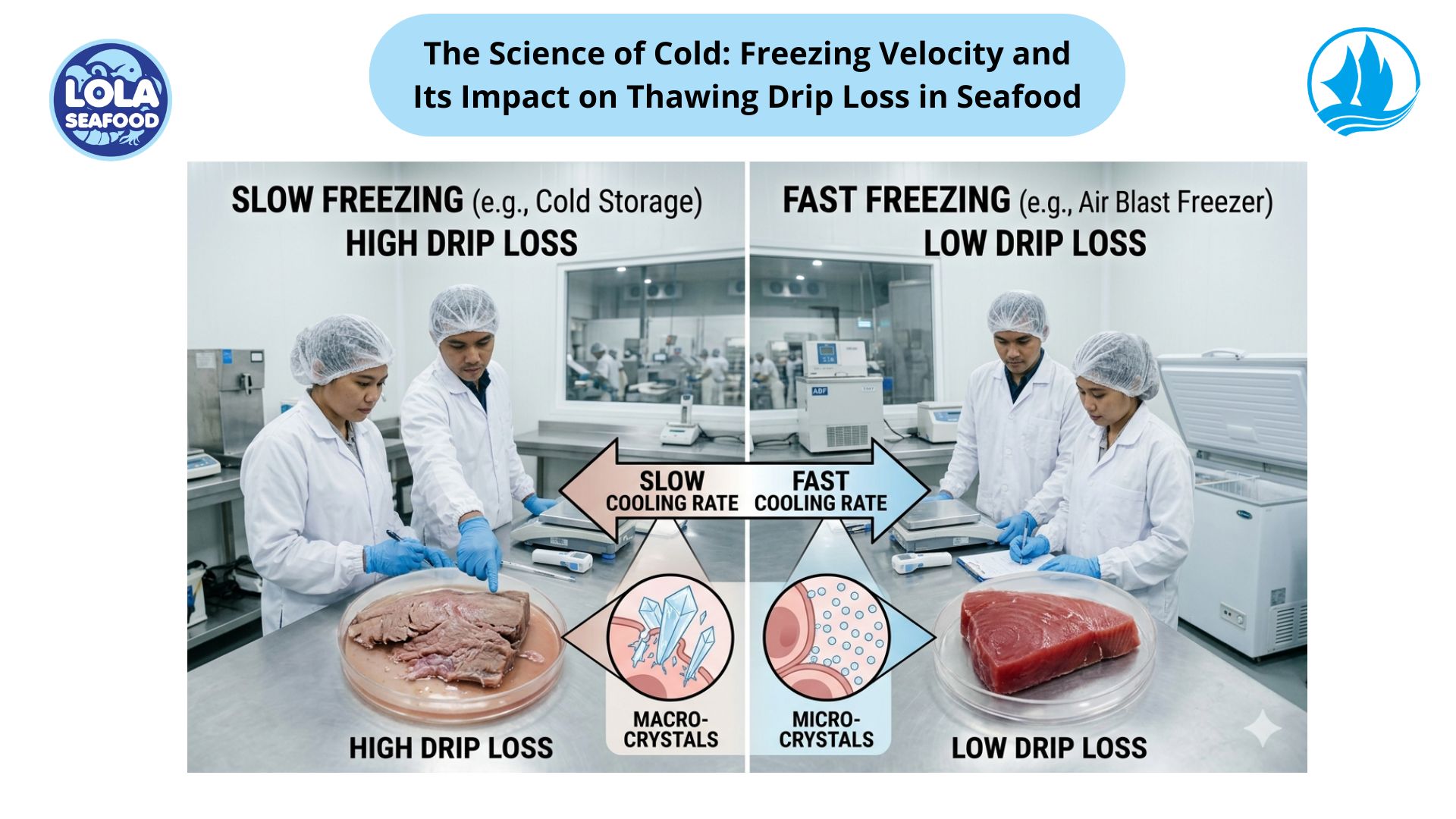
kelolalaut.com In the high-stakes world of industrial fish processing, the quality of a product isn't just judged by how it looks when it comes out of the water, but by how it behaves when it reaches the chef's kitchen. One of the most critical indicators of seafood quality is drip loss—the moisture that escapes from fish muscle tissue during the thawing process. This phenomenon is directly dictated by the freezing velocity applied during the initial preservation stage.
Understanding the relationship between how fast a fish freezes and how much liquid it loses upon thawing is essential for any processing plant aiming to deliver premium-grade seafood.
The Biological Blueprint of Fish Muscle
To understand drip loss, we must first look at the composition of fish. Fish muscle is roughly 75% to 80% water, held within a complex matrix of proteins (mostly myofibrillar proteins like actin and myosin). This water isn't just "sloshing around"; it is chemically bound or physically trapped within the cellular structures.
When we freeze fish, we are essentially turning that internal cellular water into ice crystals. The size and location of these crystals are the primary "architects" of drip loss.
Slow Freezing: The Enemy of Quality
When fish is frozen slowly—such as in a standard cold storage room without active air circulation—the temperature drops gradually. This slow decline leads to a phenomenon known as macro-crystallization.
- Extracellular Ice Formation: In slow freezing, ice crystals begin to form in the spaces between the cells first. Because the solute concentration is lower outside the cells, water is osmotically drawn out of the cells to join these growing ice clusters.
- Cellular Dehydration and Physical Damage: As these extracellular ice crystals grow, they become large, jagged, and sharp. They physically puncture the delicate cell membranes and compress the muscle fibers.
- The Resulting Drip Loss: When the fish is eventually thawed, the damaged cell membranes can no longer hold the internal fluids. The water, along with dissolved proteins, vitamins, and minerals, simply leaks out. This results in a "dry" or "stringy" texture and a significant loss in product weight and nutritional value.
Fast Freezing: The "Quick-Freeze" Advantage
Fast freezing, typically achieved through technologies like Air Blast Freezing (ABF) or Cryogenic Freezing, forces the fish through the "Critical Zone" (0oC to -5oC) in a matter of minutes rather than hours. This rapid transition leads to micro-crystallization.
- Intracellular Ice Formation: Because the temperature drops so fast, water doesn't have time to migrate out of the cells. Instead, tiny ice crystals form simultaneously inside and outside the cells.
- Preserving Integrity: These microscopic crystals are too small to rupture the cell walls. The biological structure remains almost entirely intact, "locking" the moisture and nutrients in place.
- Minimal Drip Loss: Upon thawing, the water remains trapped within the cellular matrix. The fish retains its original firmness, glossy appearance, and succulent mouthfeel—qualities that are indistinguishable from fresh, never-frozen seafood.
The Economic Consequences of Drip Loss
For a processing company, the relationship between freezing speed and drip loss isn't just a scientific curiosity; it's a matter of profit and loss.
- Yield Retention: High drip loss means the customer pays for a certain weight but receives less usable protein after thawing. In large-scale exports, a 3% to 5% difference in drip loss can equate to millions of dollars in lost revenue annually.
- Protein Denaturation: Drip loss isn't just water; it’s "nectar" containing soluble proteins. Losing this liquid changes the chemical composition of the fish, often leading to an off-flavor or a "rubbery" texture that can damage a brand's reputation.
Variables Influencing the Freezing-Drip Relationship
While velocity is the primary driver, other factors interact with freezing speed to determine the final drip loss:
- Fat Content: Fatty fish (like Salmon or Mackerel) generally exhibit lower drip loss than lean white fish (like Cod or Tilapia) because fat acts as a buffer and does not freeze into sharp crystals.
- Post-Mortem State: Fish frozen in pre-rigor (immediately after harvest) typically shows better moisture retention than fish frozen in post-rigor, as the proteins have not yet begun to break down naturally.
- Thawing Velocity: Interestingly, the speed of thawing also matters. Even a perfectly quick-frozen fish can suffer if thawed too slowly in warm conditions, which allows for enzymatic breakdown.
If youre interested in our Whiting Fish Whole Round,Barramundi Fillet Skin On,Catfish Fillet Skinless,Cobia Fillet Skinless,Coral Trout Fillet Skin On,Barramundi Whole Round / Whole Gilled Gutted Scaled,Corvina / Croaker / Jew Fish Whole Round / Whole Gilled Gutted Scaled,Black Pomfret Whole Round,Red / Scarlet Snapper Fillet Portion,Parrotfish Fillet Skinless,Baby Octopus Flower please do not hesitate to contact us through email and/or Whatsapp

 Standards in Modern Seafood Processing.jpg)

.jpg)