Ensuring Purity: Strategies for Guaranteeing Heavy Metal-Free Fish Exports
By. Puji Widyastuti - 31 Mar 2026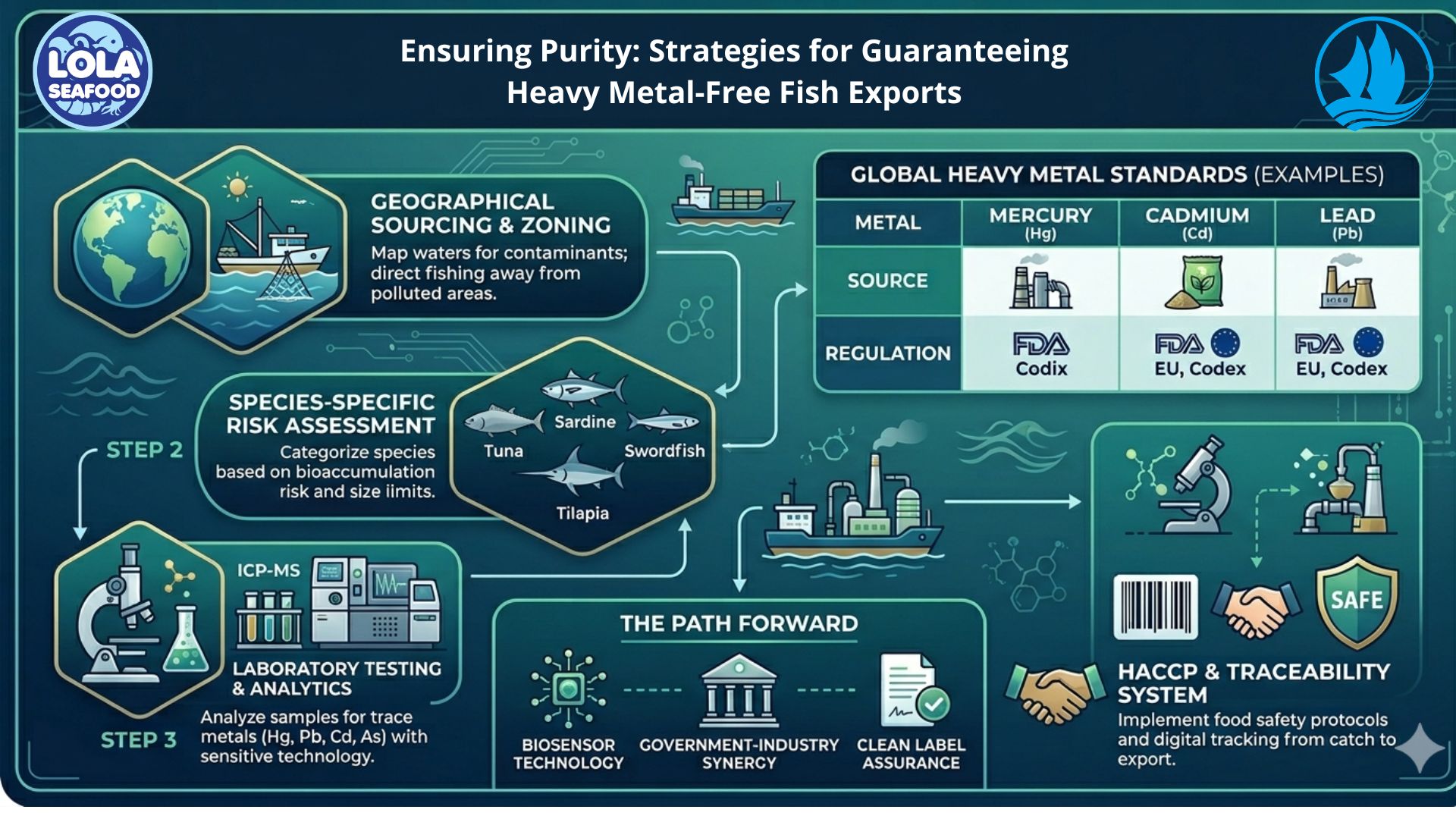
kelolalaut.com The global seafood trade is a multi-billion dollar industry characterized by complex supply chains and stringent regulatory oversight. As consumer awareness regarding food safety grows, the demand for high-quality, uncontaminated fish has never been higher. Among the various safety concerns, heavy metal contamination—specifically mercury, lead, cadmium, and arsenic—poses the most significant threat to both public health and international trade compliance.
For exporting nations, ensuring that fish products are free from these toxic elements is not just a matter of ethics; it is a critical economic necessity. A single shipment found to exceed maximum residue limits (MRLs) can lead to costly rejections, blacklisting of exporters, and damage to a nation’s reputation.
The Nature of the Threat
Heavy metals are persistent environmental pollutants. Unlike organic contaminants that may break down over time, metals remain in the ecosystem indefinitely. They enter the marine environment through industrial discharge, mining activities, and atmospheric deposition.
The primary challenge lies in bioaccumulation and biomagnification. Small organisms absorb trace amounts of metals, which are then passed up the food chain. Large, predatory species—such as Tuna, Swordfish, and Marlin—often harbor the highest concentrations because they live longer and consume vast quantities of smaller fish. For exporters, this means that the "purity" of the product is often determined long before the fish is even caught.
A Multi-Layered Strategy for Export Quality
To guarantee that fish exports meet international standards (such as those set by the EU, the FDA, or the Codex Alimentarius), a comprehensive management system must be implemented.
1. Rigorous Geographical Sourcing and Zoning
The first line of defense is monitoring the waters. Regulatory bodies must conduct regular environmental mapping of fishing grounds. By testing water quality and sediment, authorities can identify "hot zones" where heavy metal concentrations are naturally high or spiked due to industrial runoff.
- Action: Directing fishing fleets away from contaminated coastal areas toward cleaner, deep-sea environments.
- Result: Reducing the baseline risk of contamination at the source.
2. Species-Specific Risk Assessment
Not all fish carry the same risk profile. Exporters must categorize their products based on biological vulnerability. While sardines or tilapia may show negligible metal levels, pelagic species require much stricter scrutiny.
Note: Implementing size limits is a practical proxy for safety. Since older, larger fish have had more time to bioaccumulate toxins, exporting younger (but mature) specimens can significantly lower the risk of exceeding lead or mercury thresholds.
3. Laboratory Testing and Modern Analytics
Visual inspection is useless against heavy metals; the solution lies in the lab. Exporters must utilize advanced analytical chemistry to verify safety. The gold standard for this is Inductively Coupled Plasma Mass Spectrometry (ICP-MS).
- Sensitivity: ICP-MS can detect metals at parts-per-billion (ppb) levels.
- Certification: Exports should be accompanied by a Health Certificate from an ISO/IEC 17025 accredited laboratory. This provides the "scientific passport" required to clear customs in premium markets like Japan or the United States.
4. Implementing HACCP and Traceability
The Hazard Analysis and Critical Control Points (HACCP) system is the backbone of seafood safety. In the context of heavy metals, the "Critical Control Point" often starts at the receiving dock.
- Traceability: Digital tracking systems (such as Blockchain) allow buyers to trace a fillet back to the specific vessel and coordinates where it was caught.
- Audit Trails: Maintaining a transparent paper trail ensures that if a contamination issue arises, the source can be isolated immediately without recalling the entire national export stock.
Navigating Global Regulatory Standards
One of the greatest hurdles for exporters is the lack of a single global standard. For example, the European Union typically enforces some of the strictest cadmium limits in the world, particularly for cephalopods (squid and octopus).
|
Metal |
Common Source |
Impact on Export |
|
Mercury (Hg) |
Industrial waste / Volcanoes |
High risk in predatory fish; strictly limited by FDA/EU. |
|
Cadmium (Cd) |
Fertilizer runoff / Mining |
Often found in shellfish and cephalopods. |
|
Lead (Pb) |
Leaded fuels / Smelters |
General contaminant; strict limits for all food fish. |
To succeed, exporters must stay "ahead of the curve" by adopting the most stringent standard available, ensuring their product is eligible for any market globally.
The Path Forward: Technology and Collaboration
The future of heavy-metal-free fish lies in technology. Researchers are currently developing biosensors that could allow for rapid, on-site testing at the processing plant, providing instant feedback before the product is even frozen.
Furthermore, there must be a synergy between the government and the private sector. Governments should provide the infrastructure (clean water, waste management, and accredited labs), while exporters must commit to the highest ethical standards of sourcing.
If youre interested in our Whiting Fish Whole Round,Barramundi Fillet Skin On,Catfish Fillet Skinless,Cobia Fillet Skinless,Coral Trout Fillet Skin On,Barramundi Whole Round / Whole Gilled Gutted Scaled,Corvina / Croaker / Jew Fish Whole Round / Whole Gilled Gutted Scaled,Black Pomfret Whole Round,Red / Scarlet Snapper Fillet Portion,Parrotfish Fillet Skinless please do not hesitate to contact us through email and/or Whatsapp
.jpg)