The Blue Economy: The Financial Value and Market Dynamics of the Grouper Fish Industry
By. Fajar - 19 May 2026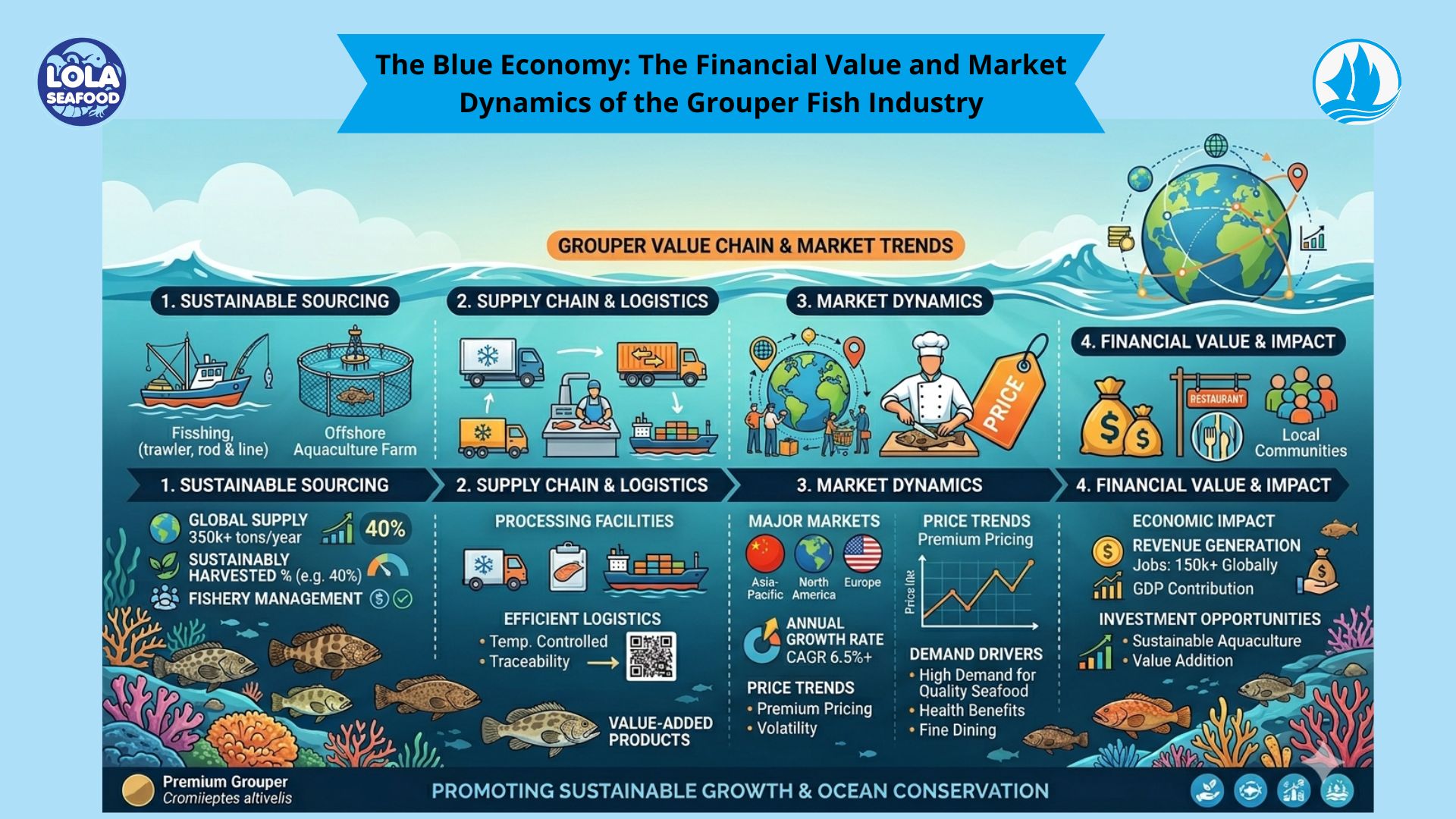
kelolalaut.com In the global seafood trade, few species command as much financial respect and economic weight as the grouper fish (ikan kerapu). While marine biologists praise its ecological role and nutritionists celebrate its health profile, economists and entrepreneurs view the grouper through a different lens: as a high-value commodity driving a multi-billion-dollar market.
From local coastal communities in Southeast Asia to luxury seafood markets in Hong Kong, Singapore, and New York, the financial ecosystem surrounding grouper is a fascinating study of premium pricing, supply-demand dynamics, and high-return investments.
1. A High-Premium Luxury Commodity
Unlike mass-market fish such as tilapia, pangasius, or even certain tuna species, grouper occupies a "premium luxury" segment in the global market. It is rarely sold as a cheap, processed frozen food. Instead, its financial value is deeply tied to its freshness, size, and species type.
The Live Seafood Trade Premium
In international culinary hubs—particularly in Cantonese cuisine—the Live Reef Food Fish Trade (LRFFT) represents the pinnacle of seafood luxury. Groupers are transported alive in specialized oxygenated tanks from catch sites to high-end restaurants.
The financial markup for live grouper is astonishing. While frozen grouper might fetch a standard market price, a live, healthy grouper can command anywhere from $30 to over $100 per kilogram at retail, depending on the specific variety. The Tiger Grouper (Kerapu Macan) and the highly coveted Giant Grouper (Kerapu Kertang) sit comfortably at the top of restaurant invoices, generating immense profit margins for supply chains capable of keeping the fish alive from ocean to kitchen.
2. Investment and High Returns in Grouper Aquaculture
As wild stocks become highly regulated to prevent overfishing, the financial focus has rapidly shifted toward aquaculture. Investing in grouper farming has become an incredibly lucrative venture for marine entrepreneurs, particularly in Indonesia, Malaysia, and the Philippines.
Here is an overview of why grouper aquaculture is highly attractive from a venture capital and investment perspective:
|
Financial Factor |
Market Advantage |
|
High Return on Investment (ROI) |
Premium market prices outpace initial setup and feed costs over time. |
|
Strong Export Demand |
Continuous buying power from East Asian markets guarantees cash flow. |
|
Scalability |
Farms can scale from small coastal cages to advanced land-based systems. |
|
Waste Utilization |
High-yield fillets mean minimal product loss, maximizing revenue per fish. |
The Cost-to-Profit Structure
While the initial capital expenditure (CapEx) for grouper aquaculture—such as building secure floating sea cages or installing Recirculating Aquaculture Systems (RAS)—is higher than that of freshwater fish, the operational profit margins are significantly wider.
Groupers are efficient feed converters compared to other premium marine fish. Once a juvenile reaches its commercial weight (typically around 600 grams to 1 kilogram), its market value exponentially exceeds the cumulative cost of fingerlings, specialized feed, and labor, yielding lucrative net profit margins for farmers.
3. Driving Coastal Economies and International Trade
On a macro-economic scale, the grouper industry acts as a major financial engine for developing coastal nations.
Boosting Local Economies
For countries like Indonesia, which possesses vast archipelagic waters, the grouper trade is a vital source of foreign exchange currency. Small-scale fishermen and local aquaculture cooperatives benefit directly from the export-driven demand. When local farmers sell their harvest to international exporters, it injects wealth directly into rural coastal economies, creating jobs in hatcheries, feed manufacturing, logistics, and processing facilities.
Global Supply Chain Dynamics
The financial flow of the grouper market relies on a highly synchronized international supply chain. Because time is money—especially in the live fish trade—logistics companies have developed optimized air-freight routes to transport grouper across borders within hours. This high-efficiency supply chain ensures that value is maintained at every step, allowing exporters, logistics providers, and wholesalers to each capture a lucrative slice of the final retail price.
A Golden Investment from the Ocean Depths
The financial narrative of the grouper fish proves that sustainability and profitability can go hand in hand. As global wealth increases and consumer preferences lean heavily toward premium, healthy protein sources, the demand for this exquisite reef fish is projected to grow even further.
Whether looked at from the perspective of a coastal farmer scaling up a sea-cage operation, a logistics mogul optimizing cold-chain transport, or a restaurateur serving elite clientele, the grouper is far more than just a culinary masterpiece. It is a robust, high-performing asset in the global blue economy—a true testament to the immense financial value hidden beneath the ocean waves.
If youre interested in our Whiting Fish Whole Round,Barramundi Fillet Skin On,Catfish Fillet Skinless,Cobia Fillet Skinless,Coral Trout Fillet Skin On,Barramundi Whole Round / Whole Gilled Gutted Scaled,Corvina / Croaker / Jew Fish Whole Round / Whole Gilled Gutted Scaled,Black Pomfret Whole Round,Red / Scarlet Snapper Fillet Portion,Parrotfish Fillet Skinless,Baby Octopus Flower,Bonito Fillet Portion Cut,Catfish Fillet Skinless,Coral Trout Fillet Skinless,Baby Octopus Flower Baby Octopus Whole Cleaned Baby Octopus Whole Round Barramundi Fillet Portion Cut please do not hesitate to contact us through email and/or Whatsappp
.jpg)
 Statement The Financial Heartbeat of a Business.jpg)
.jpg)
 Statement The Financial Heartbeat of a Business (1).jpg)