The Backbone of Fish Processing Logistics
By. Wiwik Rasmini - 17 Jun 2026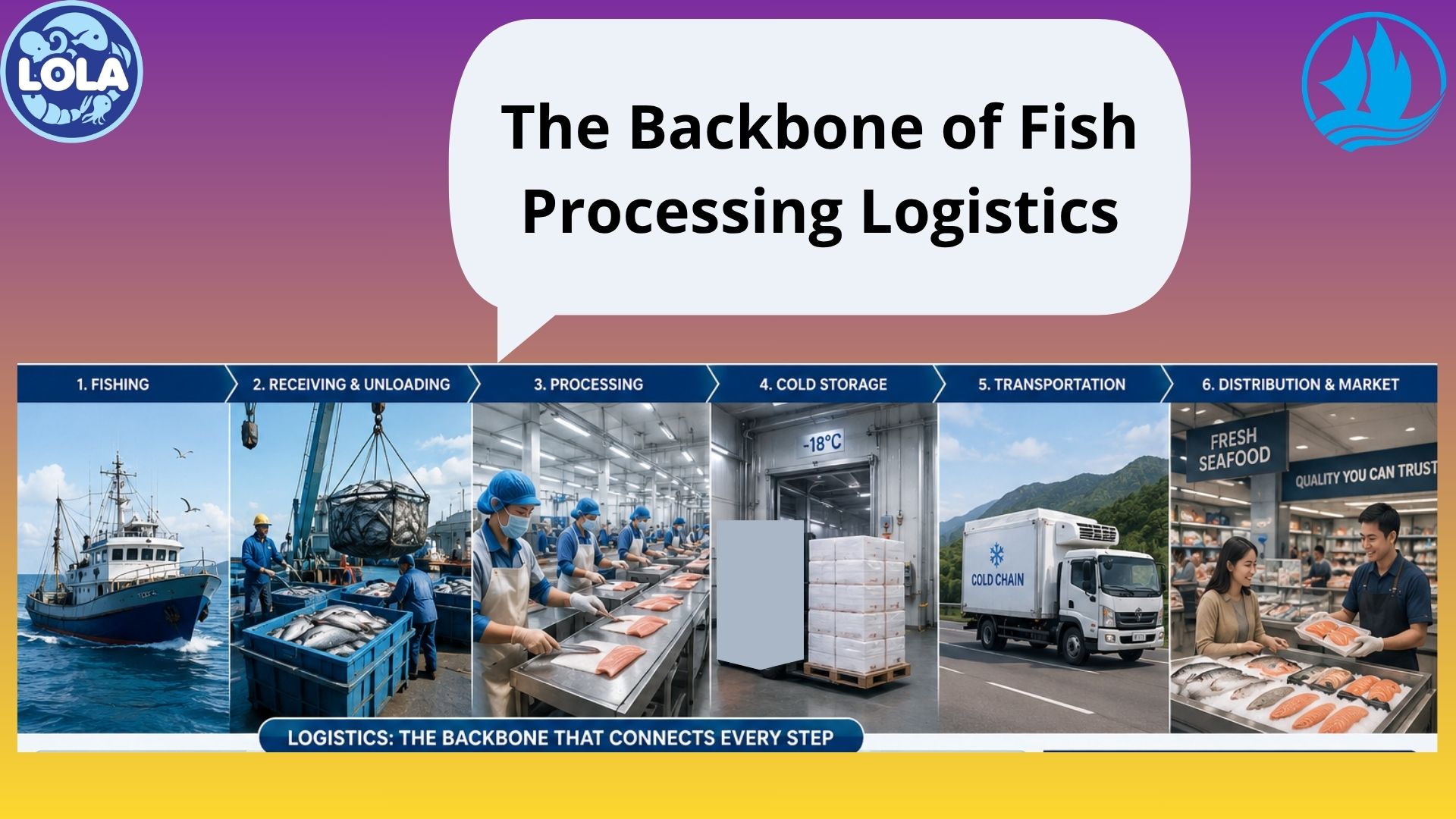
kelolalaut.com The global seafood industry is a marvel of modern logistics. Every day, millions of tons of fish are harvested from the world’s oceans and aquaculture farms, destined for dinner plates thousands of miles away. Yet, behind every perfectly preserved fillet or neatly packaged can of tuna lies an incredibly complex, fast-moving, and unforgiving supply chain. In the seafood sector, logistics is not just about moving boxes from point A to point B; it is about racing against time, maintaining sub-zero temperatures, and preserving the delicate quality of a highly perishable commodity. Logistics is quite literally the backbone of fish processing.
The Perishability Challenge: Cold Chain Logistics
The single greatest hurdle in fish processing logistics is the rapid degradation of the product. The moment a fish is caught, enzymatic and bacterial actions begin to break down its flesh. To halt this process and ensure food safety, maintaining an unbroken "cold chain" is paramount.
Cold chain logistics refers to the seamless network of temperature-controlled environments—from the fishing vessel’s refrigerated hold to processing facilities, refrigerated trucks, distribution centers, and finally, the retail display case.
For fresh seafood, temperatures must be kept strictly between 0°C and 4°C (32°F to 39°F). For frozen products, the industry standard is -18°C (0°F) or lower. A temperature abuse of even a few degrees for a short period can stimulate histamine development or bacterial growth, rendering an entire shipment worthless. Therefore, logistics providers utilize advanced reefer (refrigerated) containers equipped with real-time IoT telemetry. These sensors track temperature, humidity, and location, instantly alerting operators if a deviation occurs.
From Ocean to Factory: First-Mile Logistics
The logistical journey begins with "first-mile logistics"—the transition from harvest to the processing plant. Fishing vessels operating on the high seas often stay out for weeks. To maintain quality, many modern vessels double as "factory trawlers," where fish are bled, gutted, sorted, and blast-frozen within hours of harvest.
For coastal or artisanal fisheries, the logistics are different but equally intense. Vessels must land their catch quickly at ports, where insulated trucks packed with slurry ice wait to transport the raw material to nearby processing hubs. In this phase, scheduling is everything. Processing factories operate on tight shifts; a delay in the arrival of fishing boats or transport trucks can lead to factory downtime or, worse, spoiled raw material.
[Harvest / Catch] ➔ [Port / Landing] ➔ [Refrigerated Transport] ➔ [Processing Plant]
Inside the Plant: Intralogistics and Traceability
Once the fish reaches the processing plant, logistics shifts inward. Intralogistics—the management of material flow within the facility—must be highly optimized. Speed and hygiene dominate this phase. Automated conveyor systems, grading machines, and filleting lines must move the fish through washing, cutting, portioning, and packaging as quickly as possible to minimize exposure to ambient room temperatures.
Furthermore, modern fish processing logistics is deeply intertwined with traceability. Consumers, regulators, and environmental groups increasingly demand to know exactly where and how their fish was caught. Logistics systems must integrate with digital traceability platforms using blockchain or RFID technology. Every batch of fish receives a unique digital passport. This ensures that a fillet sold in a European supermarket can be traced back to the specific vessel, ocean quadrant, and processing batch in Asia or South America.
The Last Mile: Global Distribution
Once processed and packaged, the seafood enters the complex world of global outbound logistics. Depending on whether the product is fresh or frozen, the choice of transportation varies:
- Air Freight: Reserved for high-value fresh seafood (like sushi-grade tuna or live lobsters). While expensive and carbon-intensive, it ensures that fish caught in Scotland can be served in a Tokyo restaurant within 48 hours.
- Sea Freight: The preferred choice for frozen seafood due to cost-efficiency. Massive container ships carry thousands of reefer containers across oceans, serving as the main arteries of global seafood trade.
The "last-mile logistics"—delivering from regional distribution centers to local grocery stores and restaurants—is often the most vulnerable link, requiring precise urban routing to avoid traffic delays that could compromise refrigeration.
If youre interested in our Squid Whole Round,Sweetlips Fillet Skin On,Sweetlips Fillet Skinless,Sweetlips Whole Round / Whole Gilled Gutted Scaled,White Snapper / Robinson Sea Bream Fillet Skin On,White Snapper / Robinson Seabream / Seabream Whole Round / Whole Gilled Gutted Scaled,Cuttlefish Fillet.Cuttlefish Pineapple Cut,Cuttlefish Whole Cleaned,Cuttlefish Whole Round,Emperor Fillet Skin On,Emperor Fillet Skinless,Emperor Grass Whole Round / Whole Gilled Gutted Scaled,Emperor Red Spot Whole Round / Whole Gilled Gutted Scaled,Emperor Whole Round / Whole Gilled Gutted Scaled,Giant Trevalley Fillet Skin On,Giant Trevalley Whole Round,Goldband / Crimson Snapper Fillet Portion Cut,Goldband / Crimson Snapper Fillet Skin On,Goldband / Crimson Snapper Whole Round / Whole Gilled Gutted Scaled,Grouper Black Dotted Whole Round,Grouper Fillet Portion Cut,Grouper Fillet Skinless,Gummy Shark Fillet,Halibut Fillet Skinless.Indian Mackerel Whole Round / Whole Gilled Gutted,Itoyori / Golden Threadfin Fillet Butterfly,Mahi-Mahi Fillet Skinless,Octopus Leg,Parrotfish Fillet Skin On please do not hesitate to contact us through email and/or Whatsappp
.jpg)
.jpg)
.jpg)
.jpg)
.jpg)
.jpg)
.jpg)