Customization and Compliance: The Art of Repacking to Buyer Specifications
By. Nugroho Luhur - 21 Apr 2026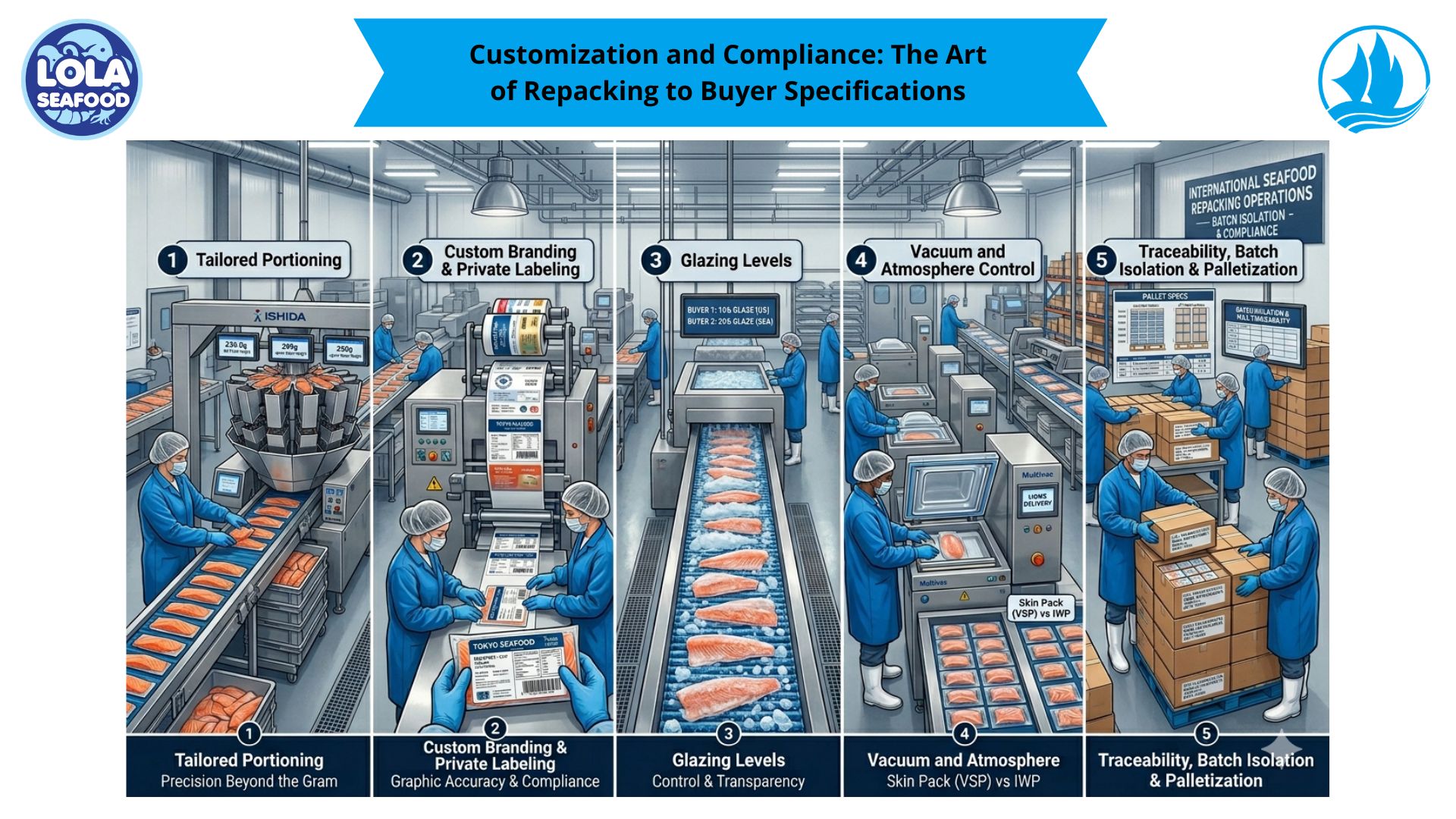
kelolalaut.com In the competitive world of international seafood trade, a "one-size-fits-all" approach no longer exists. For fish processing plants, the repack stage is where production meets personalized service. While a factory may process thousands of tons of fish, the final value is determined by how accurately that product is repacked to meet the exact, often rigid, specifications of the individual buyer.
Successfully repacking according to buyer specifications is a blend of logistical precision, aesthetic branding, and strict adherence to international safety standards.
1. Tailored Portioning: Precision Beyond the Gram
Every buyer—whether a high-end restaurant chain in Japan or a discount supermarket in Europe—has a different "ideal" product. A crucial part of a good repack is meeting these specific portioning requirements.
Some buyers may demand a "Fixed Weight" repack (e.g., exactly 250g per pack), while others prefer "Catch Weight" (natural sizes within a range). A high-quality factory uses advanced multi-head weighing systems to ensure that each fillet or steak is sorted with surgical precision. For the buyer, this consistency is vital because it allows them to calculate their food costs and margins without the risk of "giveaway" or underweight claims.
2. Custom Branding and Private Labeling
A significant portion of factory repacking involves Private Labeling. This means the factory is not just packing fish; they are packing the buyer’s brand. A superior repack result in this category is defined by:
- Packaging Material Alignment: Some buyers prioritize sustainability and request biodegradable films, while others require high-clarity nylon for maximum shelf visibility.
- Graphic Accuracy: The alignment of the buyer’s logo, brand colors, and font must be perfect. Smudged ink or misaligned stickers can lead to entire shipments being rejected at the destination port.
- Specific Language Compliance: Buyers in different regions require specific languages, nutritional tables, and health warnings on the repack label.
3. Glazing Levels: The Buyer’s Protective Shield
Different markets have different regulations regarding "Glaze." A buyer in the United States might request a 10% protective glaze, while a buyer in Asia might prefer 20% to withstand longer distribution chains in warmer climates.
A professional repack result demonstrates the factory’s ability to control the "Net Weight" versus "Gross Weight" accurately. Providing a buyer with exactly the amount of protective ice they requested—no more, no less—is the ultimate sign of transparency and builds long-term trust between the factory and the client.
4. Specialized Vacuum and Atmosphere Control
The technology used in the repack must match the buyer’s storage capabilities. If a buyer specializes in home delivery, they may request Skin Pack (VSP) technology because it prevents juice leakage and offers a premium look. Conversely, a wholesale buyer might prefer IWP (Individually Wrapped Pieces) in bulk master cartons for easier distribution to smaller markets.
The quality of the vacuum seal must be checked via "leak tests" to ensure that the integrity requested by the buyer is maintained throughout a voyage that could last 30 to 45 days in a shipping container.
5. Traceability and "Batch Isolation"
Sophisticated buyers often require that their products be packed from a specific "catch date" or a specific "vessel." A high-quality repack process ensures that there is no mixing of batches.
When the buyer receives the final result, the traceability code on the small retail pack should link back to the factory’s internal records, the cold storage log, and even the original fishing license. This level of detail is a non-negotiable specification for buyers dealing with premium species like Tuna, Salmon, or Chilean Sea Bass.
6. Master Carton and Palletization Specs
The "repack" process doesn't end at the plastic bag; it extends to how those bags are placed in the boxes. Buyers often provide specific instructions on:
- Carton Strength: Using double-wall corrugated boxes to prevent crushing.
- Loading Patterns: How many bags per box and how many boxes per pallet to maximize space in their specific warehouse racking system.
If youre interested in our Whiting Fish Whole Round,Barramundi Fillet Skin On,Catfish Fillet Skinless,Cobia Fillet Skinless,Coral Trout Fillet Skin On,Barramundi Whole Round / Whole Gilled Gutted Scaled,Corvina / Croaker / Jew Fish Whole Round / Whole Gilled Gutted Scaled,Black Pomfret Whole Round,Red / Scarlet Snapper Fillet Portion,Parrotfish Fillet Skinless,Baby Octopus Flower please do not hesitate to contact us through email and/or Whatsapp


.jpg)